Public Speaking Anxiety That Only Shows Up Sometimes? Here's Why Your Confidence Changes With Audience Size
You're confident presenting to your team. But put you in a room with senior executives and public speaking anxiety takes over.
You can lead meetings with complete clarity. But the moment there's a spotlight, you lose your train of thought.
You're masterful at your day-to-day work—whether you're a physician tending to patients or a data scientist running teams. But when you're put on the spot in a high-stakes moment, your center disappears.
The unpredictability is the worst part.
If this sounds familiar, you're not alone. And contrary to what you might think, this isn't a public speaking problem.
Why Do I Get Nervous When Presenting? Understanding Unpredictable Speaking Anxiety

Most people experience what I call unpredictable speaking anxiety—confidence that appears in some situations but vanishes in others. The pattern seems random, but it's actually quite predictable.
Here's what's happening:
When you're comfortable, your focus is clear. You're aligned in your attention. You're present fully and can speak from a grounded place.
When you're uncomfortable—in front of executives, in high-stakes situations, or whenever you have to prove yourself—your attention splinters.
Your nervous system dysregulates. You go on alert. You can't think in that same embodied way.
This shows up as:
Overthinking or brain fog
Losing your train of thought
Going blank or freezing
Heart racing or palpitations
Speaking too fast
Not being able to form cohesive thoughts
Physical symptoms like shortness of breath
Why Working Harder on Public Speaking Makes Anxiety Worse
When people notice their fear of public speaking fluctuates, they usually think: "I need to get better at public speaking."
So they work harder. They over-prepare. They script everything. They practice obsessively.
And they become less confident, not more.
Here's why: Over-preparation perpetuates the problem.
When you spend days scripting what you'll say, you're reinforcing the belief that you can't trust yourself in the moment. When you try to memorize talking points, you're splitting your attention between what you want to say and trying to remember what you planned to say.
Your attention splinters further. Your nervous system stays dysregulated. You become less present, not more.
Public Speaking Anxiety Isn't a Communication Issue—It's a Focus Issue
Speaking anxiety isn't about communication skills. You communicate perfectly when you're comfortable.
It's about focus.
When your attention consolidates—when you're fully present in your body, grounded in the moment, centered on your audience's needs—your voice stabilizes.
When your attention splinters—between what you want to say, how you think you're being perceived, whether you sound professional enough, if you're forgetting something—your voice disappears.
How to Manage Public Speaking Anxiety by Consolidating Your Focus
The solution isn't to work harder on communication. It's to strengthen your capacity to stay focused when your attention wants to split.
Focus is a muscle. You can actually strengthen it.
Here's how:
1. Get Out of Your Head and Into Your Body
When your nervous system activates, trying to think your way through speaking anxiety makes it worse. Instead:
Notice three points of physical contact (chair, desk, floor)
Feel your feet on the ground or your back against the chair
Take one conscious breath, extending your exhale
This isn't about "calming down." It's about anchoring your attention in your body instead of your spiraling thoughts.
2. Shift Your Focus from Perception to Impact
Instead of asking: "How do I sound? Do I seem confident?"
Ask this: "What does my audience need to know? How can I support them?"
This redirects your empathy from a distraction (scanning for approval) to a focusing mechanism (centering on service).
3. Use Structure Instead of Scripts
Don't memorize what to say. Instead, learn how to organize your thinking on the fly.
The Golden Nugget Framework:
Step 1: Your main point (the "10th floor" view)
Step 2: Your why (one sentence explaining your reasoning)
This structure works because it's simple enough to access under pressure. You're not memorizing content—you're using a framework to organize whatever you need to say in the moment.
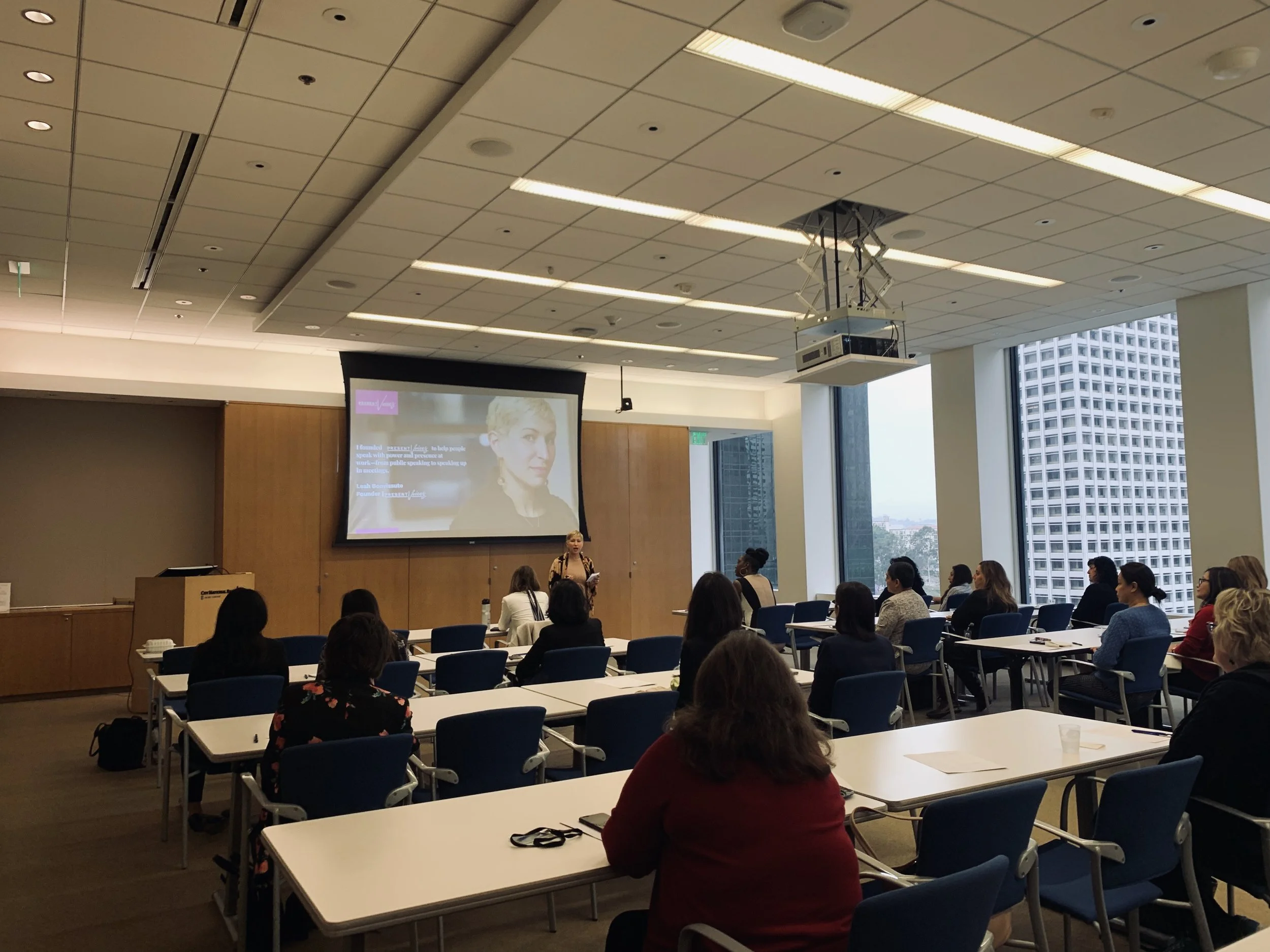
How Audience Size Affects Speaking Anxiety (And What to Do About It)
There's a shift that happens from small group presentations to public speaking on larger stages. It's similar to what happens when we go from being in a physical space with other people to a Zoom environment. This is group dynamics at play.
But here's what most people don't realize: the size of the audience isn't what triggers your anxiety. It's what the audience size represents to your nervous system.
A tiny room of 15 people can feel more intimidating than a stage of 500 if those 15 people include senior leaders you need to impress. A one-on-one conversation can trigger more speaking anxiety than a group presentation if that one person holds power over your career.
It's not about the number of people. It's about the stakes.
When you consolidate your focus, you can stay present regardless of:
Audience size
Who's in the room
How much is riding on the moment
Whether things go off-script
Why This Approach Works for Fear of Public Speaking
When you consolidate your focus:
Your nervous system regulates
Your attention stops splitting
You access your expertise without over-preparing
You stay present even when things go off-script
Your confidence stabilizes across different settings
You stop working harder and start being more yourself.
The Pattern of Speaking Anxiety Can Change
If your speaking confidence fluctuates with audience size, you're not broken. Your communication skills aren't the problem.
Your attention is splintering in high-stakes moments. And attention is something you can strengthen.
Public speaking anxiety feels unpredictable because you've been treating it as a communication problem. But once you understand it as a focus issue, you have something concrete to work with.
Focus is a muscle. When you strengthen it, you can express yourself fully and freely in every room—even the ones where your voice usually disappears.
Does your voice disappear in certain rooms?
Take the 2-minute assessment to discover your confidence pattern.
Take the 2-Minute Assessment